2026-02-05
From Demolition to Rebirth: FENGYU Featured by TaiwanPlus at Taiwan's Circular Construction Exhibiti
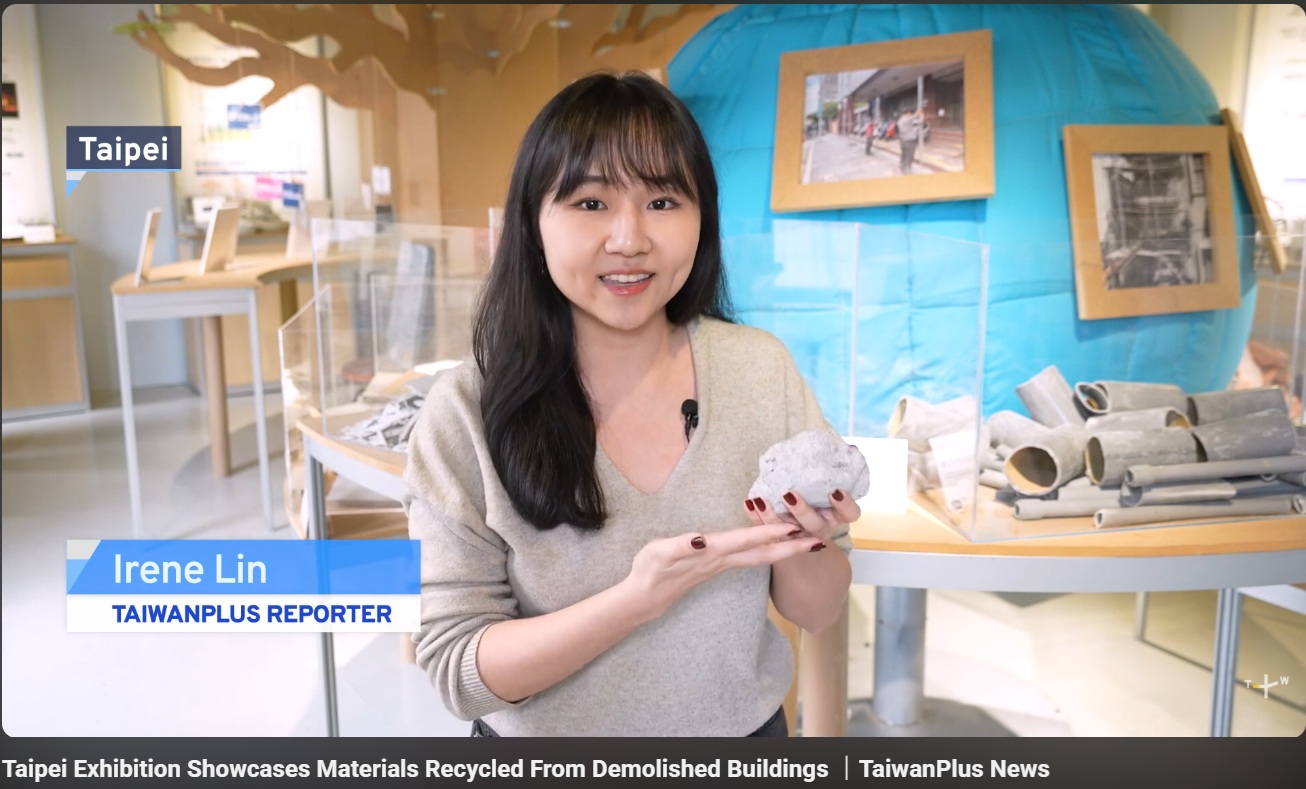
International spotlight on Taiwan's circular construction shift
TaiwanPlus recently reported from Taipei on how Taiwan's construction and recycling sectors are accelerating circular building practices—moving materials away from landfills and back into productive use. The segment emphasized that reinforced concrete and red bricks can account for about 95% of a demolished building's total weight, and that this material can be processed into fine recycled aggregates for structural applications, as market acceptance continues to grow.
FENGYU participated in the exhibition by presenting a national-level demonstration project: Ministry of Health and Welfare (MOHW) Disease Prevention Center construction, recognized as Taiwan's first pilot case to illustrate circular construction in a government facility renewal pathway.
Taiwan's first pilot: materials recovered from the former Disease Prevention Center
In the interview, Wu Tsuey-Shya, Chief Brand Officer, FENGYU United Engineering, stated:
"What you're seeing here is recovered from our former disease prevention center. The concrete and red bricks were carefully dismantled and sorted. At present, part of this material has already been used in our ongoing construction projects, and in the future, we hope that 100% can be transformed into construction materials"
In the TaiwanPlus report, recovered materials from the former Disease Prevention Center—such as concrete and red bricks—were shown as being carefully dismantled and sorted. The report noted that part of these recovered materials has already been reused in ongoing construction projects, with the ambition to ultimately transform 100% of the recovered material into new construction inputs.
This approach directly addresses the environmental impacts of conventional concrete production, including intensive extraction of sand and gravel and the large volumes of construction waste produced at end-of-life. Recovered and recycled inputs can reduce waste, lower resource pressure, and support greener building outcomes.
“Good demolition creates good materials”: refined dismantling and sorting as the enabler
A key message echoed across the exhibition is that circularity begins before recycling—at the demolition stage. The official exhibition framing emphasizes turning “demolition” into a controlled, high-quality recovery process through refined dismantling and source separation, demonstrating an end-to-end pathway from dismantling, classification, processing, and onward application into low-carbon and circular construction methods.
What this means for Taiwan and Asia: scaling trust in recycled structural inputs
Circular construction is ultimately a trust challenge: designers, contractors, owners, and regulators must align on quality assurance, traceability, and performance. The TaiwanPlus report noted that wider adoption of recycled aggregates in structures will take time as market acceptance grows.
FENGYU's role is to translate circular principles into buildable reality—linking refined dismantling, quality recovery, and real project deployment so that circular materials become dependable options for future public works and private developments alike.
Key Facts
-
TaiwanPlus featured FENGYU at Taipei's circular construction exhibition (published Feb 5, 2026).
-
Demolition materials (reinforced concrete + red bricks) can account for about 95% of total weight and can be processed into recycled aggregates for future use.
-
A government facility renewal project—the former MOHW Disease Prevention Center—demonstrates refined dismantling and sorting for circular reuse, aiming toward full material transformation.
-
The initiative aligns with Taiwan MOENV's circular resource policies and cross-sector collaboration.
YouTube TaiwanPlus FENGYU
豐譽 FENGYU C&C Podcast EP.11 link